The Wrong Wall: Getting Your Air-Con Thermostat to Tell the Truth
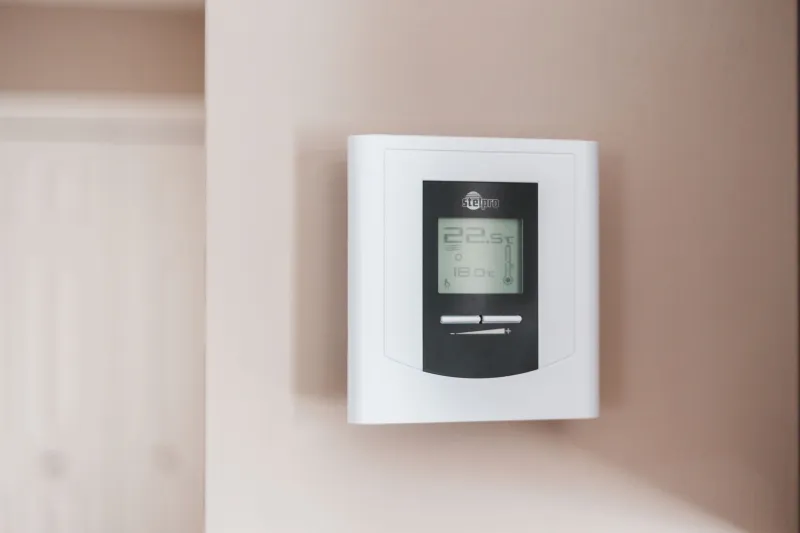
We get called out to plenty of systems that turn out not to be broken at all. The compressor is fine, the gas is where it should be, the filters are clean enough. The problem is that the thermostat has been asked to judge a room from the worst possible seat in the house. It sits on a south-facing wall in a Cheam semi, or a foot above a radiator in a Wallington shop, and it dutifully reports whatever the wall is feeling rather than what the room is doing.
That mismatch is behind a lot of the complaints we hear: rooms that never quite settle, units that short-cycle, bills that creep up, one end of the flat chilly while the other is stuffy. Before you book an engineer, it is worth working out whether your sensor is telling the truth.
What a thermostat is actually measuring
A room thermostat does not average the whole room. It reads the air in its own little pocket, usually within half a metre or so. Wall splits and cassettes are slightly different again: on many systems the temperature is sensed in the return air, the stuff being pulled back into the indoor unit. That makes the grille, the filter and the space in front of the unit part of the measurement, which is why a blocked filter or a sofa pushed up against the intake can throw the readings off without anything electrical failing.
Either way, the rule is the same. Put the sensor somewhere unrepresentative and the system will cool to the wrong number, then stop, then start again.
Five spots that tend to fib
The sunny wall. A sensor in direct sun on a November afternoon can read several degrees above the room, so the unit knocks off early and the room drifts warm. Later, once the sun has moved round, it reads cold and over-cools.
The kitchen. Steam, a hob and a boiling kettle will drag a reading upwards within minutes. If the controller lives in the kitchen but the room you care about is the lounge, the lounge will end up cool while the kitchen sensor chases a number that never settles.
Beside a radiator or a hot pipe. This matters more now that the heating is back on for the winter. A thermostat near a radiator, a towel rail or a hot-water pipe reads the heat source, not the room, and a reversible system can end up confused about which mode it should be in.
Draughty spots. A hallway by the front door, a wall with a letterbox in it, or a spot above a sash window in an older Sutton terrace will all read low on a blustery day. The system then works harder than it needs to.
High shelves and dark corners. Above a television, next to a lamp, behind a curtain, tucked behind a sofa: all of these trap warm air or block airflow. So does the inside of a cupboard, which we have seen more than once.
The small-office version of the same problem
In a shop or small office, the usual mistake is putting the controller wherever the wiring was easiest. That often means the stockroom, the corridor, or the wall behind the till, where a monitor, a printer and a card machine are quietly adding heat to the reading. Add a door that opens onto the street every ninety seconds and the sensor spends its day averaging Sutton High Street with the back office.
If your premises have more than one room, ask whether the system uses a remote sensor or a wireless room unit. Moving the control point is often cheaper than adding zoning, and it fixes a surprising number of comfort complaints.
A ten-minute check you can do yourself
You do not need test gear. A cheap kitchen thermometer will do.
- Stand it on a saucer about 1.2 metres off the floor, away from windows, radiators and lamps, in the middle of the room you actually use.
- Note the reading at three points in the day, say mid-morning, early afternoon and late afternoon, along with what the controller says at the same moment.
- If the two readings differ by more than a degree or two, the sensor position is worth questioning.
- Check whether the unit is being shaded or sunlit at each reading, and whether the heating has come on in between.
- On a wall split, look at the intake grille. Dust, a curtain or a piece of furniture within half a metre will skew the return-air reading.
- Hold a tissue near door frames and windows on a windy day to find the draughts the thermostat might be feeling.
If it needs moving
Relocating a wired thermostat is not a weekend DIY job; it involves mains wiring and, on some systems, reconfiguring which sensor the controller listens to. That is a short visit for someone who knows the kit, and it is usually a screwdriver-and-patience job rather than a replacement system. If your controller is wireless, or your system supports a remote sensor, there may be no wiring at all.
One practical note for this time of year: as the heating goes on and the air-con goes off, the same sensor is now reading for the other season. A thermostat that was tolerable in August can be genuinely misleading in November, because the radiator under it is the warmest thing in the room.
If the readings in your home or premises do not match what the controller is claiming, get in touch and we will take a look. Most of these visits are quick, and quite a few end with a thermostat on a different wall and nothing else changed.