Black Marks and Buzzing Switches: A Pre-Winter Electrical Once-Over for Sutton Air-Con
Every winter we get the same call. Something like: the air-con keeps tripping the switch, and can you come today because the other half is working from home and the back room is freezing. Usually the fault has been sitting there since August, quietly getting worse behind a sofa or a stack of shoeboxes.
November is a good month to deal with it. The cooling season has wound down, the heating side is about to work harder, and an electrician or installer can actually get to you before the diary fills up. So here is a plain-English walk around the electrical side of a domestic or small-shop system, written for people who are handy but sensible.
Why the cold months are the demanding ones
People assume air-con is a summer thing. It is not, not really. A reversible system running in heat mode pulls more current than it does in cooling, because you have got the compressor plus, on a cold morning, defrost cycles and possibly a crankcase heater doing their thing. Add a heated towel rail, a tumble dryer and a couple of fan heaters into the same set-up and you find out very quickly how much headroom your wiring actually has.
That is why a unit that behaved all August can start nudging a breaker in December. Nothing has broken. The load has just gone up.
The dedicated circuit, and why it is not optional
A proper installation gives the air-con its own circuit back to the consumer unit. Not a spur off the ring main in the kitchen. Not a share with the immersion heater.
Why it matters: an air-con unit draws a big lump of current at start-up, then settles. If it is sharing a circuit with a washing machine and a dishwasher, the protective device is sized for the shared load, not the surge. You get nuisance tripping, warm accessories, and eventually a tired connection.
If you are in a Sutton terrace or a converted flat in Carshalton and you are not sure what you have got, look at the consumer unit. A well-labelled board will say something like 'A/C' or 'Heat pump' or 'Bedroom 2 air con'. If every breaker says 'Sockets' or 'Lights', that is worth a conversation with whoever installed it.
The RCD that will not stay up
An RCD is the safety device that trips when current leaks to earth, and it is the one that protects people rather than wiring. A 30mA RCD is standard on modern boards.
Two things are worth knowing. First, RCDs get tested with a proper tester, and they can go sluggish with age. Second, and more usefully for a homeowner, water in the wrong place causes RCD trips far more often than people expect. Condensate that has found a new route, a drip tray overflowing, a wet outdoor isolator after a fortnight of rain and leaf litter.
So if the RCD goes every time it rains, do not keep resetting it and hoping. That is a pattern, and patterns have causes.
The isolator nobody knows about
Most installations have a local isolator near the indoor unit or by the outdoor unit, so an engineer can work safely without killing the whole house. It is usually a small switched fused spur or a rotary switch on the wall.
Find yours. Note where it is. And check that it is not buried behind a fridge or boxed in by a shelf someone built in 2019. If a fuse needs changing or a unit needs isolating in a hurry, that switch needs to be reachable.
Extension leads, and the great British workaround
We have all done it. The unit is in the wrong corner, the socket is in the other one, and a four-way extension appears.
A properly installed air-con should never be running off a domestic extension lead. Those leads are rated for short-term, modest loads, and the coiled-up ones get warm in a way that is genuinely not fine. If your system needs a longer cable run, that is a fused spur job or a new circuit, and it is a job for someone qualified.
The outdoor unit supply
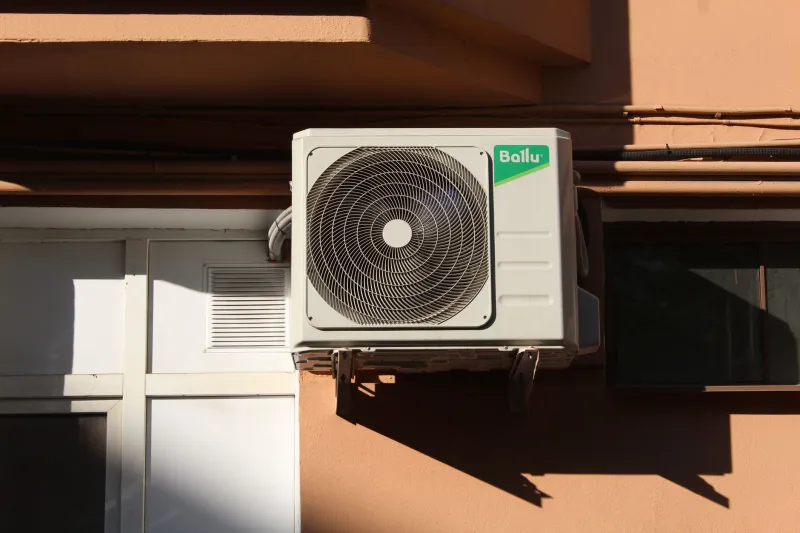
The outside half of the system gets the least attention and takes the most weather. Things worth a look from ground level, without touching anything:
- Cable entry. The cable should go into the unit through a proper gland, not a hole with a bit of mastic smeared over it. Water tracking down a cable into a terminal block is a classic.
- Condition of the isolator. Cracked lid, water inside the enclosure, green crust on the terminals.
- Scorch marks or browning on the casing around the supply, or a smell of hot plastic.
- Rodent damage. Sutton's squirrel and rat population does enjoy a bit of cable sheath, especially in sheds, garages and along fence lines in the Hackbridge and Beddington direction.
What you can check yourself
Keep it to eyes, nose and hands-off. So:
- Look at plugs and sockets for browning, blackening or a melted look.
- Notice any buzzing, crackling or fizzing from a switch or spur. Turn it off at the board if it is safe to do so, and get someone out.
- Check for warmth on accessories that should not be warm. A wall switch that is noticeably hot to a light touch is a problem.
- Watch for trips that repeat. If it goes twice in a month, book it in rather than resetting a third time.
- Test your RCD with the button on the board. Once every few months is the usual advice, and it costs nothing.
What must be left alone
Anything behind a screw. Consumer units, terminal blocks, wiring inside the outdoor unit, the connections at the isolator, anything to do with earthing or bonding. In the UK, notifiable electrical work in a dwelling falls under Part P, and installations should follow BS 7671. That is not gatekeeping for its own sake. Air-con circuits sit on the boundary between fixed wiring and appliance, and getting it wrong tends to show up as a fault months later in a place you cannot see.
Equally, if a breaker has tripped and resetting it immediately trips again, stop. Something is shorting, and repeatedly energising a dead short is how you turn a repair bill into a replacement bill.
A short November checklist
Turn the system off at the isolator for five minutes and have a look around. Cable entry tidy? Isolator dry and undamaged? Nothing stacked against the indoor unit? No scorch marks, no warm plugs, no smell? RCD trip button test done? If your board is unlabelled, label it while you are there, because next winter you will be glad you did.
If anything looks off, or you simply have not had the electrical side looked at since it went in, we are happy to come and give it a once-over. Booking in November is considerably more pleasant than being squeezed in during a cold snap, and it is a lot cheaper than replacing a compressor that has been fed a dodgy supply all winter.